


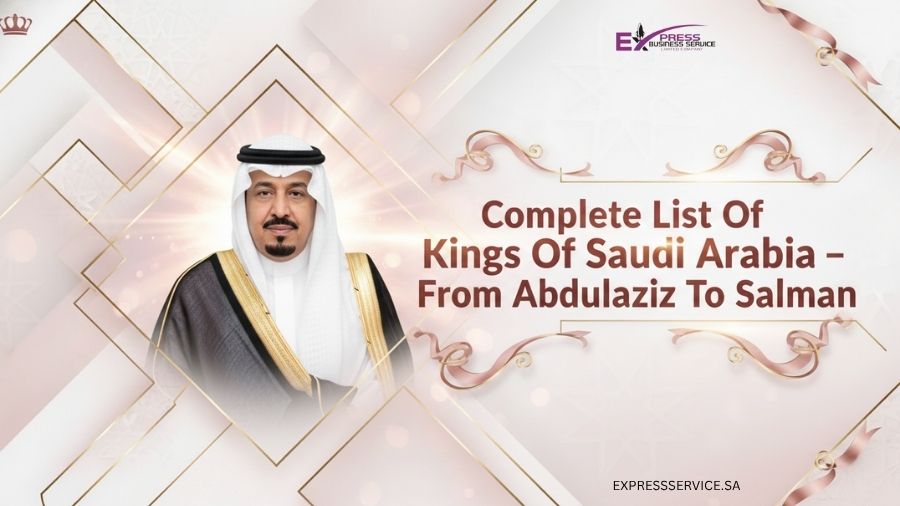
Complete List Of Kings Of Saudi Arabia – From Abdulaziz To Salman

One of the most powerful countries in the world, the Kingdom of Saudi Arabia, has a history of unification, rapid expansion, and significant transformation. A single, resolute leader founded the modern state, and successive Kings of Saudi Arabia have led the nation ever since. Through navigating regional difficulties and world events, each monarch has been instrumental in forming the country that exists today.
A comprehensive list of Saudi Arabia’s monarchs, from King Abdulaziz, the country’s founding father, to King Salman, the current monarch, is given in this article.
List of Kings of Saudi Arabia
King Abdulaziz bin Abdulrahman Al Saud is an extraordinary figure who marks the beginning of the modern kingdom’s history.
1. King Abdulaziz bin Abdulrahman Al Saud (Reigned – 1932–1953)

A. Dates of Reign – He unified the country, which was formally renamed the Kingdom of Saudi Arabia in 1932, and ruled from 1932 to 1953.
B. The Unifier – King Abdulaziz, also called Ibn Saud, was the first monarch of Saudi Arabia. He started his amazing adventure in 1902 when he and a few devoted men retook Riyadh, the Al Saud family’s ancestral home.
C. Key Achievement – The unification of the diverse tribes and regions of the Arabian Peninsula into a single, independent state was his most significant accomplishment. It was a drawn-out process that called for excellent leadership, military prowess, and diplomacy.
D. The discovery of oil – Importantly, the first commercial oil reserves were found in the late 1930s, during his rule. Although the enormous inflow of wealth mostly happened after his passing, this “black gold” set the groundwork for Saudi Arabia’s future economic dominance.
E. Legacy – He guaranteed the kingdom’s sovereignty on the international scene and established the fundamental tenets of the state, which are based on Sharia law, an Islamic legal system.
The Succession of Sons (The Early Kings)
In a unique arrangement among contemporary monarchies, the throne passed laterally among the founder’s surviving sons after King Abdulaziz’s death, as opposed to directly to the son of the reigning king (primogeniture). This guaranteed that the first generation of rulers would continue to hold the reins of power.
2. King Saud bin Abdulaziz Al Saud (Reigned – 1953–1964)

A. Dates of Reign – 1953–1964
B. Difficulties – King Saud oversaw the first stage of development and concentrated on carrying out his father’s plan. Significant obstacles, such as internal administrative problems and financial difficulties brought on by the unexpected influx of oil money, did, however, face his reign.
C. End of Reign – He was forced to abdicate in favor of his half-brother, Faisal, due to domestic family conflicts and a national financial crisis.
3. King Faisal bin Abdulaziz Al Saud (Reigned – 1964–1975)

A. Dates of Reign – 1964–1975
B. The Reformer – King Faisal is regarded as a strong statesman and reformer. He modernized the bureaucracy and stabilized the nation’s finances.
C. Foreign Policy – Known for his anti-communist and pan-Islamic stances, he was a highly significant figure in the Arab world. His choice to spearhead the 1973 oil embargo against Western countries that backed Israel during the Yom Kippur War was evidence of Saudi Arabia’s increasing influence on the world stage.
D. Legacy – He maintained a strong commitment to the kingdom’s religious ideals while launching extensive educational and infrastructure initiatives. He was tragically assassinated in 1975.
4. King Khalid bin Abdulaziz Al Saud (Reigned – 1975–1982)

A. Dates of Reign – 1975–1982
B. Period of Prosperity – Because of the enormous oil revenues from the 1973 oil crisis, King Khalid’s reign was characterized by enormous economic prosperity.
C. Development Focus – By directing this wealth toward previously unheard-of investments in infrastructure, such as new ports, schools, hospitals, and roadways, the kingdom’s modernization was accelerated.
D. The Gulf Cooperation Council – He played a key role in the formation of the GCC in 1981, which promoted economic cooperation and regional security among Gulf states.
5. King Fahd bin Abdulaziz Al Saud (Reigned – 1982–2005)

Later Saudi kings carried on the modernization trend, addressing social and economic issues and becoming more involved in international politics.
A. Dates of Reign – 1982–2005
B. Custodian of the Two Holy Mosques – All succeeding kings have used the honorific title “Custodian of the Two Holy Mosques” (referring to Mecca and Medina) since King Fahd adopted it. The kingdom’s religious function was strengthened by this title.
C. Modernizing Government – He presided over significant changes, such as the 1992 adoption of the Basic Law of Government, a charter akin to a constitution.
D. The Gulf War – One of his most notable foreign policy moments was his resolute leadership during the 1990–1991 Gulf War, which allowed foreign troops to enter the kingdom and liberate Kuwait. After suffering a stroke in his later years, he gave Crown Prince Abdullah, his half-brother, a lot of authority.
6. King Abdullah bin Abdulaziz Al Saud (Reigned – 2005–2015)

A. Dates of Reign – Although he was the de facto ruler starting in 1995, his reign lasted from 2005 to 2015.
B. Cautious Reformer – King Abdullah was renowned for his cautious attempts at educational and social reform. He founded the King Abdullah University of Science and Technology (KAUST) and was a fervent supporter of education.
C. Women’s Rights – He significantly increased the rights of women by giving them the ability to vote and run for office in municipal elections, as well as by appointing them to the Consultative Council (Shura Council).
D. Foreign Policy – He suggested the Arab Peace Initiative in 2002 and was actively involved in regional peace initiatives.
The Current Era (King Salman and Vision 2030)
King Salman, the current ruler, has presided over the start of the biggest and fastest change in Saudi Arabia’s history.
7. King Salman bin Abdulaziz Al Saud (Reigned – 2015–Present)

A. Dates of Reign – 2015–Present
B. Custodian of the Two Holy Mosques – The current ruler and King Abdulaziz’s twenty-fifth son is the custodian of the Two Holy Mosques.
C. Longtime Governor – Prior to ascending to the throne, he was in charge of Riyadh’s development from a sleepy village to a thriving metropolis for almost fifty years.
D. Visionary Leadership – The establishment of Vision 2030 and the promotion of his son, Crown Prince Mohammed bin Salman, also referred to as MBS, characterizes his reign. This ambitious plan aims to implement major social and cultural reforms, diversify the kingdom’s economy away from oil, and expand public service sectors like health and education.
E. Impact – Under his direction and the Crown Prince’s close supervision, the kingdom is going through a fast, unprecedented transition that is fundamentally changing its social and economic standing in the world.
The Unbroken Line – A Quick Saudi Kings List
Since 1932, the succession of Saudi Arabia’s monarchs has been stable and uninterrupted, passing from father to son (and then from brother to brother among the founder’s sons).
The short King of Saudi Arabia list is as follows –
| Name of King | Reign Period | Key Focus |
| Abdulaziz | 1932–1953 | Unification and State Foundation |
| Saud | 1953–1964 | Early Development and Administration |
| Faisal | 1964–1975 | Financial Stability and Global Influence |
| Khalid | 1975–1982 | Infrastructure and Regional Cooperation (GCC) |
| Fahd | 1982–2005 | Governance and Religious Authority (Custodian title) |
| Abdullah | 2005–201 | Social and Educational Reforms |
| Salman | 2015–Present | Economic Diversification (Vision 2030) |
A roadmap for the country’s journey, from tribal rule to a unified nation, and then from an oil-rich kingdom to a modern state striving for a diverse, future-focused economy under Saudi King Salman’s leadership, is included in the kings of Saudi Arabia list.
Also Read: Top 10 Popular Markets In Saudi Arabia


